
History
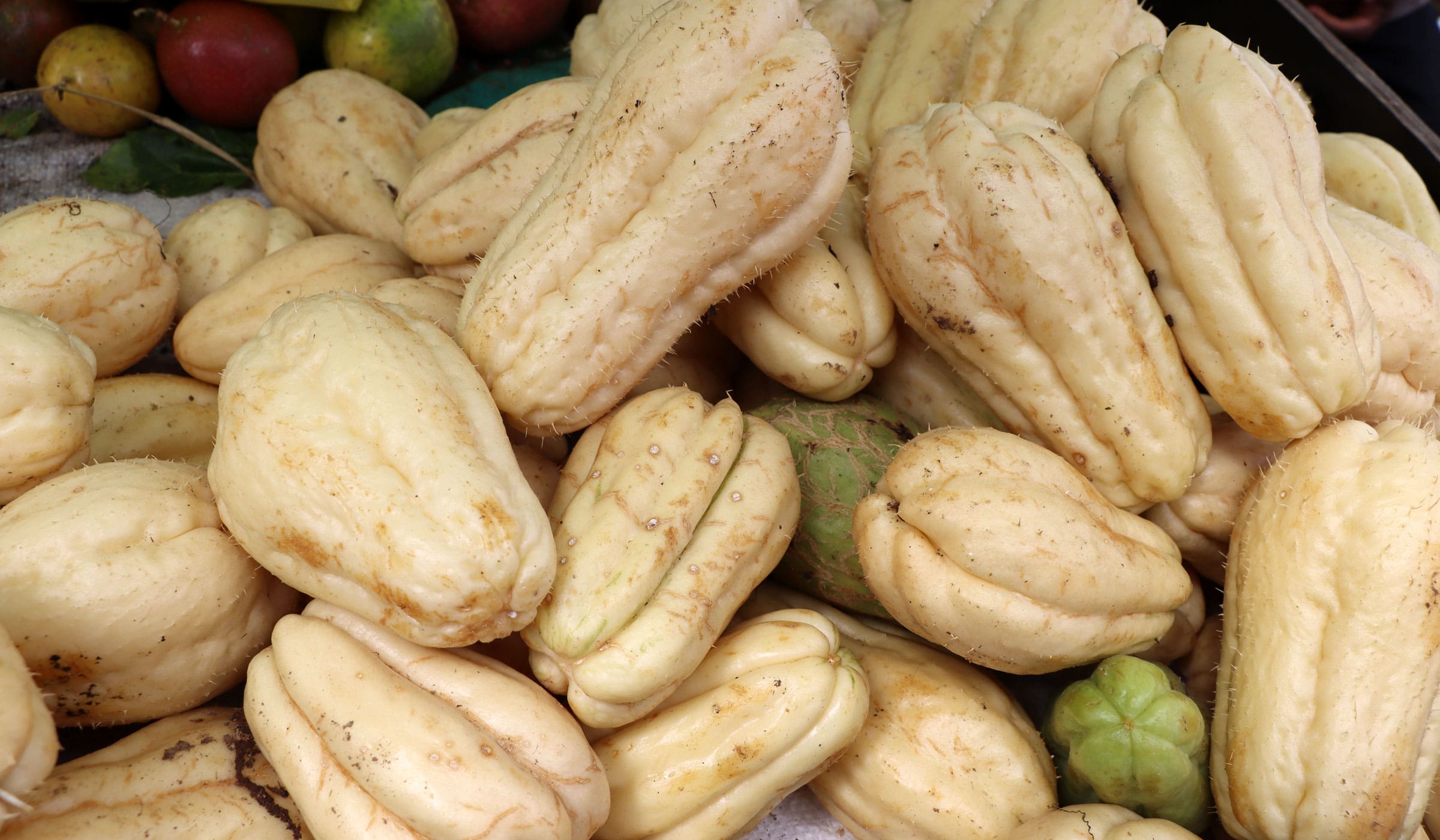
Chayote, whose scientific name is Sechium edule, is a perennial plant cultivated in tropical countries as a vegetable crop for its edible fruit. It is known as chayote (or chayotte) in mainland France, chouchou in Réunion and Mauritius, chouchoute in New Caledonia and French Polynesia, and mirliton in Haiti and Louisiana. Although botanically a fruit, it is eaten as a vegetable.
Chayote originates from Mexico, particularly from the regions of Oaxaca, Puebla, and Veracruz. It was cultivated by the Aztecs before colonization. Although documentation is scarce, it is possible that the plant was already present in the Caribbean region. Its date of introduction to Martinique is therefore unknown. Chayote spread during the 19th century to other tropical regions, including the Indian Ocean islands such as Réunion.
Varieties
There are several varieties cultivated depending on the region. The most widespread variety produces a pale green, pear‑shaped fruit. In Martinique, chayote is mostly beige, elongated, with white flesh inside. It is sweeter and juicier than the variety most common worldwide. There is also a dark green, very spiny variety.
Chayote is a perennial vine with a tuberous rootstock. It produces long stems that can reach several meters in length. The fruit contains a single elongated seed with the remarkable ability to sprout inside the vegetable itself. To grow a new plant, one simply needs to plant a chayote that has begun to sprout.
Chayote has white, watery flesh surrounded by a thick skin. It is harvested before the seed begins to develop.
The plant contains many active compounds that give it the ability to soothe burns and promote the healing of wounds and injuries.
The raw pulp of the fruit, used as a facial mask, was traditionally believed to reduce skin spots. Its fibrous flesh also aids digestion and intestinal transit.
Consumed as juice (in reasonable amounts), chayote has a diuretic effect. Its dried leaves are effective as an herbal tea for reducing high blood pressure.
Medicinal Virtues
Chayote is composed of 90% water. It is low in calories and contains twice as much vitamin C as cucumbers and zucchini.
Uses
Chayote can be eaten raw (grated in salads), cooked, baked au gratin, or stuffed. It pairs easily with other vegetables and accompanies both meat and fish dishes.
It can also be used to make a slimming herbal tea, which is also considered a good remedy for hypertension.


