
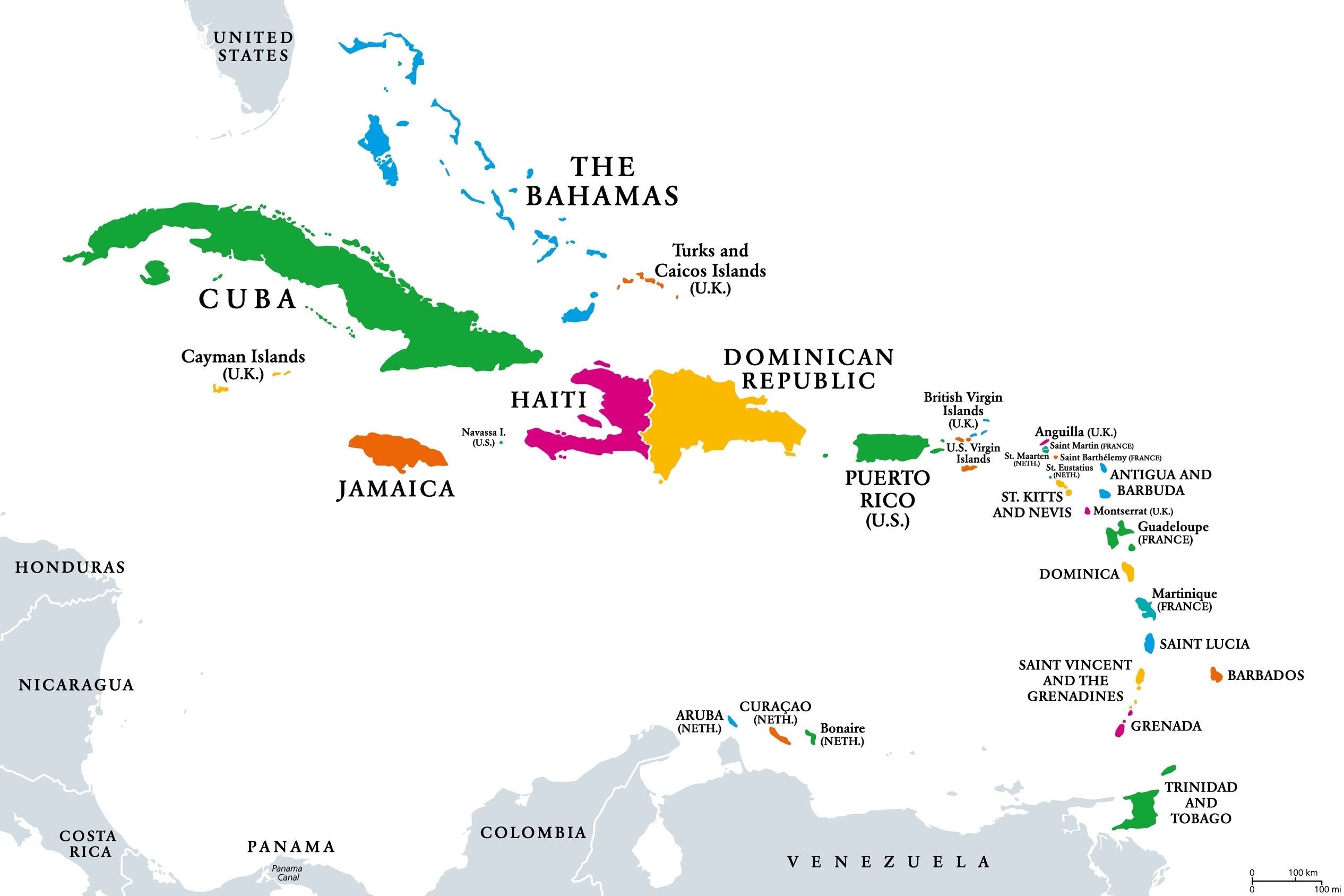
For most people around the world, the Caribbean is an archipelago of paradise islands, beaches with turquoise waters lined with coconut trees, evoking vacation vibes, exoticism, and escape. Many are unaware that this archipelago is home to nearly 42 million inhabitants, 30 states or territories dependent on European countries, around 10 spoken languages, and a rich, vibrant culture. We'll begin briefly with its geography.
Geography

The Caribbean is an archipelago located near the American continent, bathed by the Caribbean Sea.
The Caribbean—or the Caribbean region—includes the Antillean arc of the Greater and Lesser Antilles, as well as some islands or states outside this arc, such as the Bahamas and the Turks and Caicos Islands, further north. It is common to also include the Yucatán Peninsula (the southeastern region of Central America encompassing Mexico, Belize, and Guatemala), the Caribbean coast of Central America, and the coastal plains of Colombia, Venezuela, and the Guiana Plateau (Suriname, Guyana, and French Guiana).
The northernmost state in the Caribbean is the Bahamas, a group of islands. Grand Bahama, the northernmost of these, lies just 54 miles (87 kilometers) from the coast of Florida. The southernmost Caribbean island is Trinidad, located only 7 miles (about 11 kilometers) off the coast of Venezuela.
List of islands of the Caribbean archipelago in alphabetical order | ||||
|---|---|---|---|---|
| Country + Political status | Population (year) | Area (sq. km) | Capital city | Head of state |
| Anguilla (British Overseas Territory) | 15,278 inhab. (2024) | 102 | The Valley | Gouvernment: - Head of state: Charles III - Governor: Julia Crouch - Prime Minister: Cora Richardson-Hodge |
| Antigua and Barbuda (Constitutional monarchy) | 93,770 inhab. (2024) | 442 | St. John's | Government: - Head of state: Charles III - General Governor: Sir Rodney Williams - Prime Minister: Gaston Browne |
| Aruba (Netherlands Kingdom) | 107,620 inhab. (2024) | 442 | Oranjestad | Government: - Head of state: Willem-Alexander (Roi des Pays-Bas) - Governor: Alfonso Boekhoudt - Minister President: Mike Eman |
| Bahamas (Constitutional monarchy) | 401,280 inhab. (2024) | 13,962 | Nassau | Government: - Head of state: Charles III - General Governor: Dame Cynthia A. Pratt - Prime Minister: Philip E. "Brave" Davis |
| Barbados (Republic) | (282,470 inhab. (2024) | 430 | Bridgetown | Government: - Head of state: Charles III - President Sandra Mason (Republic since November 30, 2021) - Prime Minister: Mia Mottley |
| Bonaire (Municipality with special status) | 26,552 inhab. (2025 est.) | 294 | Kralendijk | Government: - Lieutenant Governor: John Soliano |
| British Virgin Islands (British Overseas Territory) | 39,470 inhab. (2024) | 153 | Roadtown | Government: - Head of state: Charles III - Governor: Daniel Pruce - Prime Minister: Natalio Wheatley |
| Cayman Islands (British Overseas Territory) | 74,457 inhab. (2024) | 264 | Cayman City | Government: - Head of state: Charles III - Governor: Jane Owen - Chef du Government: André Ebanks |
| Cuba (Republic) | 10,979,780 inhab. (2024) | 109,884 | La Havane | Government: - President of the Council of State: Miguel Díaz-Canel |
| Curaçao (Government of Netherlands and Autonomous Government) | 155,900 inhab. (2024) | 450 | Willemstad | Government: - Head of state: Willem-Alexander - Governor: Lucille George-Wout - Prime Minister: Gilmar Pisas |
| Dominica (Republic) | 66,200 inhab. (2024) | 754 | Roseau | Government: - President: Sylvanie Burton - Prime Minister: Roosevelt Skerrit |
| Dominican Republic (Republic) | 11,427,560 inhab. (2024) | 48,734 | Santo Doming | Government: - President: Luis Abinader |
| Grenada (Constitutional monarchy) | 117,210 inhab. (2024) | 350 | Saint-Georges | Government: - Head of state: Charles III - Governor: Cécile La Grenade - Ministre-President: Dickon Mitchell |
| Guadeloupe (French overseas department and region) | 378,561 inhab. (2024) | 1,628 | Basse-Terre | Government: - Head of state: Emmanuel Macron - President of the Region: Ary Chalus - President of the Departmental Council: Guy Losbar |
| Haiti (République) | 11,772,560 inhab. (2024) | 27,748 | Port-au-Prince | Government: - President: Presidential position vacant since 2021 |
| Jamaica (Constitutional monarchy) | 2,839,180 inhab. (2024) | 11,425 | Kingston | Government: - Head of state: Charles III - Governor: Patrick Allen - Prime Minister: Andrew Holness |
| Martinique (Unique French overseas collectivity) | 355,500 inhab. (est. 2025) | 1,128 | Fort-de-France | Government: - Head of state: Emmanuel Macron - President of the Executive Council of the Unique Collectivity: Serge Letchimy |
| Montserrat (British Overseas Territory) | 4,386 inhab. (2023) | 102 | Plymouth | Government: - Head of state: Charles III - Governor: Harriet Cross - Chief Minister: Reuben Meade |
| Puerto Rico (Commonwealth of the United States) | 3,203,300 inhab. (2024) | 9,104 | San-Juan | Government: - Head of state: Donald Trump - Governor: Jenniffer González-Colón |
| Saba (Caribbean Netherlands) | 2,158 inhab. (2025 est.) | 13 | The Bottom | Government: - Jonathan Johson |
| Saint Barthelemy (French overseas collectivity) | 10,562 inhab. (2022) | 24 | Gustavia | Government: - Head of state: Emmanuel Macron - Assemblée délibérante (President): Xavier Lédée |
| Saint Kitts and Nevis (Constitutional monarchy) | 48,840 inhab. (2024) | 261 | Basseterre | Government: - Head of state: Charles III - General Governor : Marcella Liburd - Prime Minister: Terrance Drew |
| Saint Lucia (Constitutional monarchy) | 179,740 inhab. (2024) | 261 | Castries | Government: - Head of state: Charles III - General Governor: Errol Charles - Prime Minister: Philippe J. Pierre |
| Saint Martin (French overseas collectivity) | 26,130 inhab. (2024) | 53 | Marigot | Government: - Head of state: Emmanuel Macron - Territorial Council (President): Louis Mussington |
| Sint Maarten (Constitutional monarchy) | 43,350 inhab. (2024) | 13 | Philipsburg | Government: - Head of state: Willem-Alexander - Governor: Ajamu Baly - Prime Minister: Luc Mercelina |
| Saint Vincent and the Grenadines (Constitutional monarchy) | 100,620 inhab. (2024) | 261 | Kingstown | Government: - Head of state: Charles III - General Governor: Dame Susan Dougan - Prime Minister: Ralph Gonsalves |
| Sint Eustatius (Caribbean Netherlands) | 3,270 inhab. (2025 est.) | 13 | Oranjestad | Government: - Lieutenant Governor: Alida Francis |
| Trinidad and Tobago (Republic) | 1,368,330 inhab. (2024) | 5,128 | Port-of-Spain | Government: - President: Christine Kangaloo - Prime Minister: Kamla Persad-Bissessar |
| Turks and Caicos Islands (British Overseas Territory) | 46,530 inhab. (2024) | 616 | Cockburn Town | Government: - Head of state: Charles III - General Governor: Dileeni Daniel-Selvaratnam - Prime Minister: Anya Williams |
| United States of America Virgin Islands (United States of America Territory) | 104,380 inhab. (2024) | 346 | Charlotte Amélie | Government: - Head of state: Donald Trump - Governor: Albert Bryan |
History
What is the history of the Caribbean?
Before Christopher Columbus’s voyages, the Caribbean was an unknown archipelago to the European world. Believing he had reached the Indies, Columbus encountered islands already populated by peoples originating from South America. Some islands were inhabited by the Arawak/Taíno—peaceful communities who lived by fishing, hunting small animals, and cultivating cassava. Others were home to the Kalinago (Carib) Indians, known as fierce warriors, hunters, and fishermen. The Kalinago expanded across the region, reportedly exterminating Taíno men and taking women as wives or servants.
Columbus approached these islands during his four voyages between 1492 and 1503, followed by other European navigators. The Spanish, British, Dutch, and French colonial empires soon began to colonize the region, competing for control of territories they viewed as gold mines for producing commodities such as coffee, cocoa, tobacco, sugarcane, and bananas for European markets.
After three centuries marked by slavery and the forced arrival of Africans, the abolition of slavery led European empires to shift their economic focus toward Asia, particularly India. Eventually, all Caribbean states acquired distinct political statuses—some gained full independence, others achieved near-complete autonomy (e.g., Commonwealth realms or constitutional monarchies), while some became integrated territories of the European states that had colonized them.
To know more about the Caribbean islands' history.
Spoken languages
There are many languages spoken in the Caribbean. In addition to the official languages introduced during colonization (Spanish, French, English, and Dutch, in order of importance based on the number of speakers), regional languages have also been added, which became predominant when Haitian Creole became the official language of the Republic of Haiti.
The spoken languages in the Caribbean are:
- Spanish: Cuba, Dominican Republic, Puerto Rico
- English: Jamaica, Trinidad and Tobago, Puerto Rico, Bahamas, Saint Lucia, Barbados, Dominique, Saint Kitts and Nevis
- French: Haiti, Guadeloupe, Martinique, Saint Barths, Saint-Martin
- Dutch : Curaçao, Sint Maarten, Aruba, Bonaire, Sint Eustatius, Saba
- Creole with French lexical base (differences exist as islands): Haiti, Guadeloupe, Martinique, Saint Lucia, Dominique, Grenada, Trinidad and Tobago, Saint-Vincent and the Grenadines
- Creole with English lexical base: All previous British colonies
- Papamiento: Netherlands Caribbean
So, do you know the Caribbean better now?
Martinique is part of the Antillean arc and, like the other islands, shares a history shaped by similar waves of migration. The Arawaks arrived first, followed by the Taínos and the Caribs, who settled there before the Europeans arrived, believing they had reached the Indies. For a long time, the Caribbean islands were referred to as the West Indies, and their inhabitants as West Indians — a name that still persists today.