
The eruption, the day Saint Peter died
Thursday, May 8, 1902, was Ascension Day. An explosion occurred in the crater of Étang Sec, whose flank had been indented since the flow of May 5. A powerful blast followed three minutes later by a pyroclastic flow blocked to the north and east by the caldera cliff and dome, which traveled through the breach in Étang Sec toward the Blanche River and swept over the city at a speed of more than 500 km/h.

At 7:52 a.m., in less than a minute, the Rivière Blanche was largely destroyed, and the ships anchored in the harbor were on fire. The explosion of the plug caused the crater to burst into flames and sent out a shock wave, an atmospheric supersonic boom (~ 450 m/s, 30 hPa of instantaneous overpressure).

This noise, unlike any other noise heard on a daily basis, was so powerful that it was unbearable to the human ear and caused the eardrums of residents several kilometers away to burst.
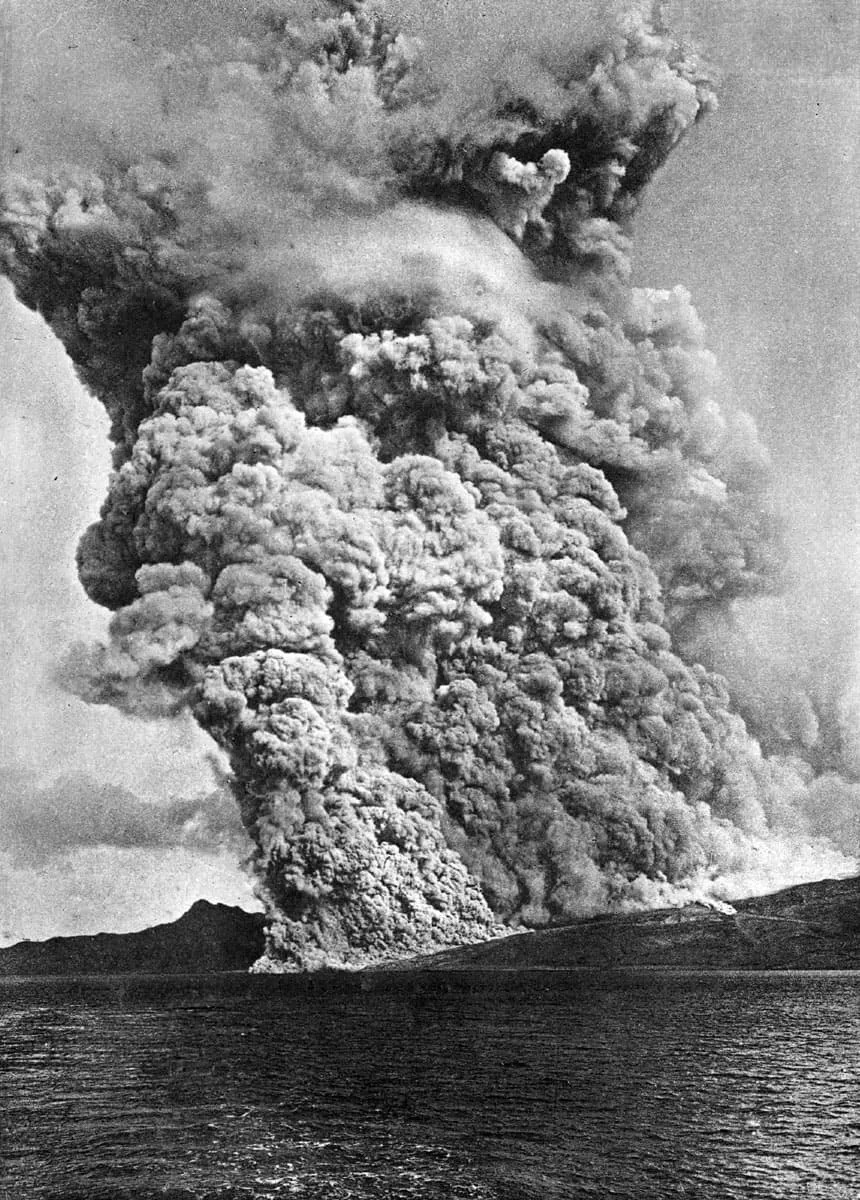
A thick cloud of gas, water, and solid particles escaped from a vent at the foot of the dome, producing a huge black mushroom cloud more than 4 km above the volcano.
It then collapsed in on itself and its descending cloud, centered on the Rivière Blanche, covered a triangular area between Étang Sec/Le Prêcheur/Saint-Pierre, more than 40 km wide, with mud, rocks, and ash, coming to a halt in the middle of the harbor, more than 1,500 m from the shore.
Fires and lahars exacerbated the destruction and increased the number of victims. Depending on where they were in the devastated area, the victims died either from the atmospheric shock wave, from inhaling hot gases, from severe burns, from falling volcanic rocks, or from collapsing buildings. Saint-Pierre was not the only town affected by the eruption.
Many victims were reported throughout the north of the island, from the Caribbean coast to the Atlantic coast, although the number was obviously higher on the Caribbean coast below Mount Pelée. Only two men and a young girl survived the eruption on May 8, thanks to the solidity and remoteness of the buildings where they were staying. However, they suffered severe burns.

The first Louis-Auguste Cyparis, a 27-year-old laborer, was locked in a prison cell for participating in a deadly brawl in a bar. The cell had very thick walls and only a narrow opening on the side facing away from the volcano. He was pulled out three days after the eruption. His body was severely burned. He joined Barnum and Bailey's “greatest show on earth,” where he was presented as “the man who lived through Judgment Day.” He is said to have been the first black celebrity in the American entertainment world.
Léon Compère, known as Léandre, was a young shoemaker who lived in a thick-walled building on the edge of the devastated area.
Much less well known is the young Havivra Da Ifrile, who escaped at the last minute on her brother's boat, which was picked up at sea by a ship called Le Suchet.
First aid arrived from Fort-de-France via the warship. Suchet arrived at the entrance to the harbor at 12:30 p.m., but the heat prevented him from entering until 3:00 p.m. Despite this, he managed to rescue sailors and passengers from various ships on fire. Once ashore, most succumbed to their injuries. Only about twenty survived.