

Arrival in Martinique and life in the plantations
The Indian in the plantation
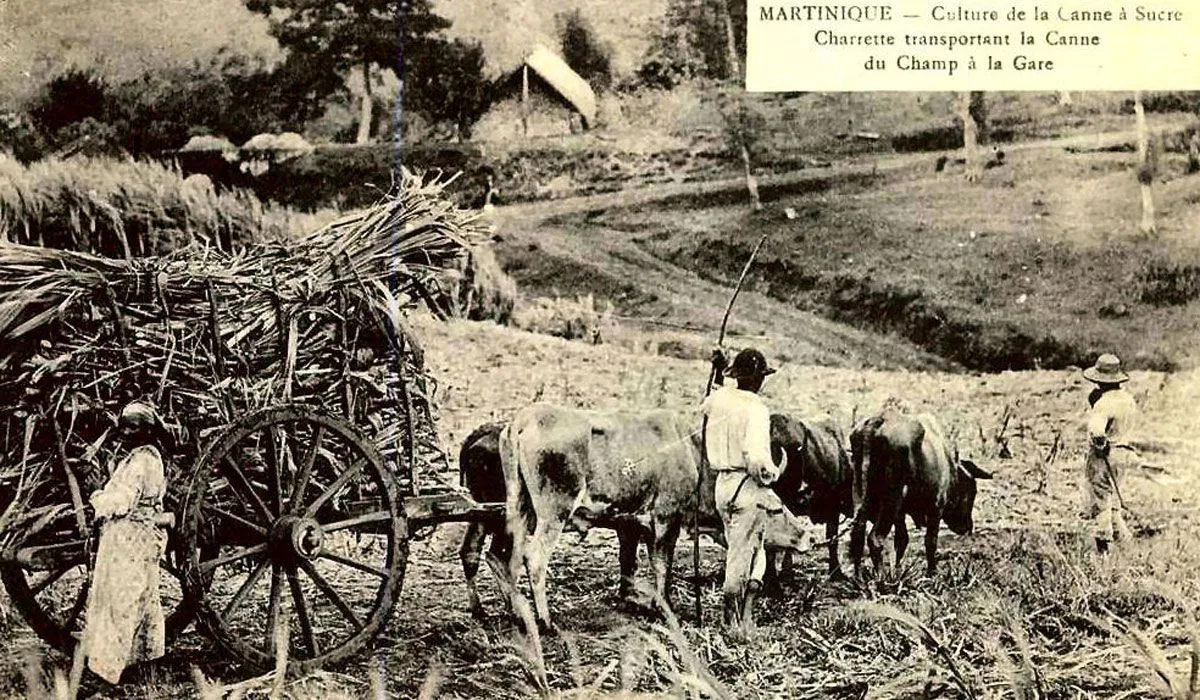
Once arrived, they integrated their work station generally in the plantations of the North of Martinique (Basse-Pointe or Saint-Pierre, the city of their arrival). The tasks were mainly the maintenance of the cane plantations, the breeding of the herds of cattle, in particular the bulls which pulled the cabouèt (cart pulled by two bulls) of cane at the factory. Blacks remained confined to harsher work because they were considered more physical than the Indians. Indian women replaced the former Black female slaves, who performed domestic chores for white planters.
Like the former slaves, they lived in the houses in the old huts left empty by the former slaves and lived in inhuman hygienic conditions (9 square meters for a whole family and without lighting!). Indian workers were preferred over black workers descended from slaves by the planters because they worked more regularly, with Blacks working only one, two, or three days a week, while Indians worked daily 26 days per month as stipulated in their contract. In addition, Indian workers were loyal to the planter who recruited them, whereas the Black workers could change employers.
Compared to the Indians, the Congos were more docile and loyal to the bosses. The latter lived in the community without integrating with the indigenous black population. The salary was on average 12.50 francs per month for men (or 40 centimes per working day), 10 francs for women, and 5 francs for non-adults. A daily food ration was also "offered" by the employer. Indian workers were paid with the "caïdon", a copper coin worth 50 cents with the initials of the planter.
This currency was used to equip themselves and to make purchases only in the shop of the planter present on the plantation or in the surroundings. When they were paid, their debt was deducted, thus remaining tied to the owners and the home. At the end of his contract, the employee was entitled to repatriation costs for himself, his wife, and his non-adult children. Government agents ensured that the signed contract was respected so that the worker was not harmed.
The hard life on the plantations
The working conditions were harsh, however. Indian workers were often given insufficient food consisting of roots and starches, salted fish, but no meat, oil, and other condiments, let alone milk. They started working in the morning, from 4:30 a.m. to 12:00 p.m.,, and in the afternoon, from 1:30 p.m. to 6:30 p.m. At this rate, they didn't even have time to prepare lunch. These men and women had to go after work to cut grass and bring bundles of fodder for the cattle in the house. They then received their food ration.
Some employers forced their recruits to work night and day, sometimes paying them late (2 to 3 months). They also worked on Sundays and public holidays until noon. The complainants were sent to prison. If they were sick and hospitalized on the plantation, they had to sweep the area around the building, removing manure from the stables. Many preferred to break their contract and choose idleness. Very early on, they opted for "marronnage" (escape from their workplace). Marooned, they were mistreated and considered dangerous savages.
Like the Blacks, they were also victims of ill-treatment, accused of theft and murder or, worse, killed in opaque conditions. For example, a French newspaper, La Bataille, recounts that on July 19 in Saint-Joseph, an enlisted man was killed by the planter who had him imprisoned in the infirmary that same morning. His wife, with three other hired staff,f noted the death and appealed to the gendarmerie, who entered the scene alone and noted the death. The Indians retract in their testimony, proof of the pressure they were under from the planters.
The Indians did not hesitate to take revenge by burning down the owners' house. Others sank into alcohol and madness. At the end of their contract, they could either re-engage generally for five years with the same planter or another planter, engage as a free worker having definitively renounced their right of repatriation or having "reserved" it, work with a free residence permit under the ordinary law regime, or be repatriated. In any case, the current economy, based largely on the sugar cane market, did not allow them other avenues of exit. The worker had the choice between hard work in the fields or poverty.
Repatriation was not systematically offered to them. The planters used their imposing position in the face of this submissive workforce without real opposition. The employees only managed to negotiate a better contract and sometimes a raise by making competition between planters. They then re-enlisted for a new five-year term. Note that a correctional or criminal conviction definitively removed the right to repatriation. At the end of Indian immigration in the 1880s, the omnipotence of the planters, afraid of losing the hires who could demand their repatriation, was even stronger. Their actions may have been condemned and combated, but the situation of the Indian soldiers was hardly going to improve. The only consideration they obtained was a piece of land on the master's property, which they could cultivate as they wished, but which was insufficient to feed them and their families. Indian immigration will last until 1885.
The General Council votes to end this same year for several reasons:
- The Indian worker returned too expensive (travel + wages for 5 years) to the landowners. In addition, he competed with the native workers.
- Competition between Indian immigrants and Black Creoles had given rise to several "racial" tensions.
At the end of immigration, the number of Indians was about 13,000 individuals, the majority of whom were free to enlist. Even when immigration was suppressed, Indians were arriving in the French colonies each year, numbering about 5,000 per year.